
ABILITY DOGS OF ARIZONA
Dedicated to providing specialized training to people and their dogs to enhance independence and quality of life since 1973.


What we do
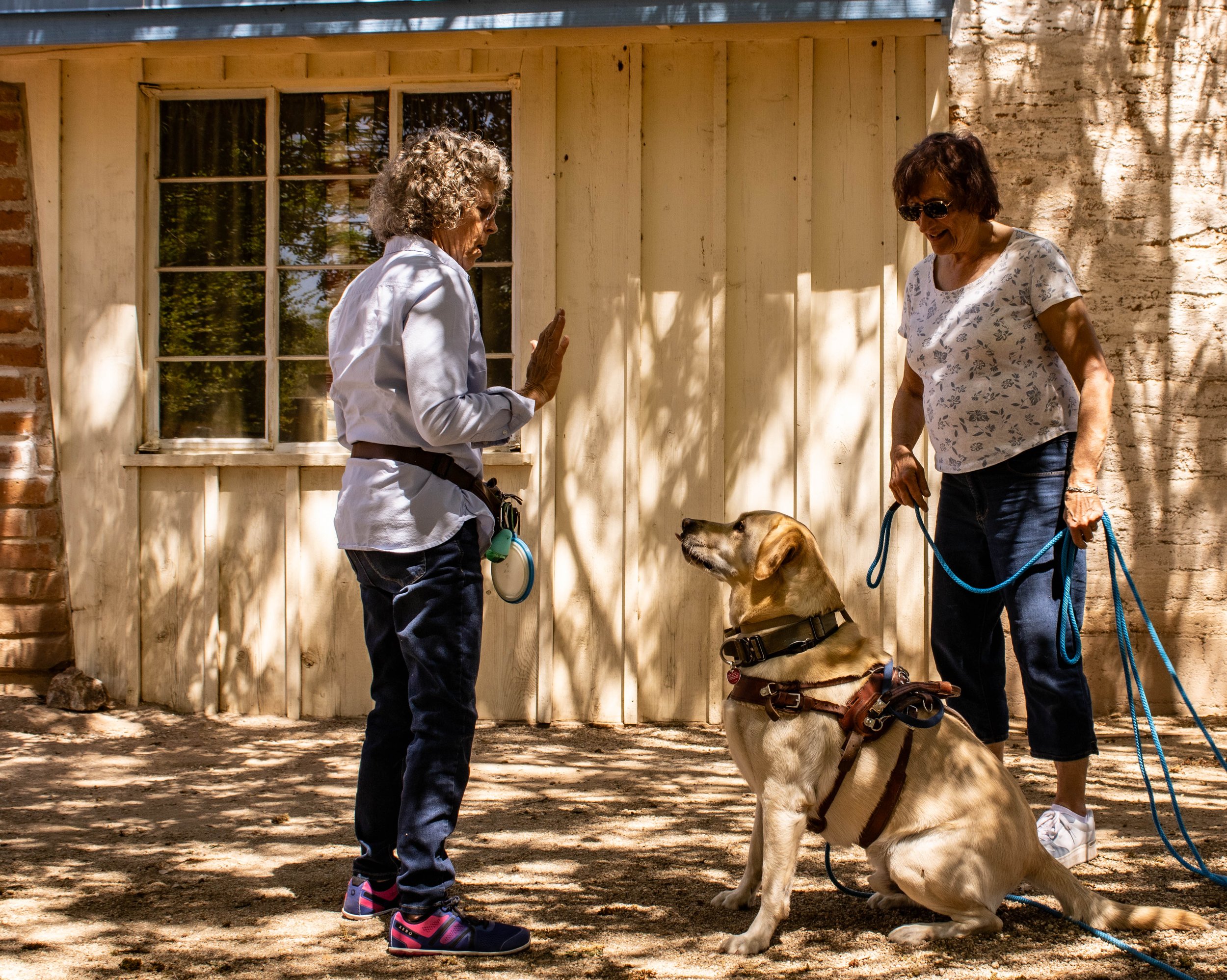
At Ability Dogs, we specialize in empowering individuals to train their own service dogs. Through our comprehensive, owner-involved training programs that typically span 12 to 18 months, we provide extensive education and support to help people with various disabilities train dogs to assist them with their daily lives. Our curriculum extends beyond service dog training to include general public classes that teach dogs of all breeds and backgrounds a wide range of skills over multi-week courses. We recognize the unique bond between humans and dogs, and harness this connection to enhance the lives of both. Our instructors are not just trainers; they are educators, mentors, and advocates for the human-canine partnership.

Why we do it
Every day, we see the profound changes service dogs make in people's lives. We believe that dogs have the ability to bring about independence, confidence, and joy in the lives all people. Specially trained dogs can perform tasks many of us take for granted, opening up a world of possibility for their human partners. We approach every human+dog team differently, understanding that every person and every dog is unique and has specific needs. By actively involving owners in the training process, we create a sense of trust and understanding between the dog and its handler, laying the foundation for a long-lasting partnership. Around here, it's not just about training dogs but about unlocking each team's potential.

-

SERVICE DOG PROGRAM
What sets us apart is that our program provides individuals with the necessary tools and support to train their own service dog with close supervision. Unlike facilities that train and deliver dogs, our expert instructors include you from the start. We help train for a variety of different tasks, including Diabetic Alert, Hearing Alert, Mobility Assistance, Psychiatric Assistance, and Seizure Response.
-
FINANCIAL AID
We understand that financial barriers can prevent people from accessing the service dog support they need. We believe in providing assistance to qualified people whenever possible through generous support from our donors. If you need a service dog but cannot afford one, apply for financial aid.
-
PET TRAINING
Ability Dogs provides a wide range of pet classes tailored to both puppies and adult dogs. With a focus on positive reinforcement, we teach dogs to make good decisions instead of merely following commands. Our goal is to foster a strong and positive bond between you and your dog while equipping them with the necessary skills to succeed as pets.
Philosophy and Core Values
Ability Dogs is dedicated to providing specialized training to people and their dogs to enhance independence and quality of life.

THE ABILITY DOGS PHILOSOPHY


Positive reinforcement is the core of what we do.
At Ability Dogs of Arizona, we champion positive reinforcement techniques for dog training. This approach rewards dogs for displaying behaviors we desire, using treats, praise, or play as incentives. Such rewards motivate the dog to repeat these behaviors, fostering a willingness to learn and experiment without fear of reprimand. Positive reinforcement not only strengthens the bond between dog and owner but also nurtures a foundation of trust and mutual respect.
Our recommended training tools include flat-buckle collars, martingale collars, and no-pull harnesses. For certain safety considerations, we may suggest the use of head halters like the Gentle Leader or Halti. Our experienced instructors are on hand to help select and properly fit the ideal equipment for your dog. Additionally, we incorporate clickers or verbal markers to refine communication between you and your canine companion.
We advocate the application of positive reinforcement beyond our program, extending to all canine activities such as competition obedience, rally, agility, nose work, barn hunt, flyball, and dock diving.
To ensure a humane and effective training environment, we strictly prohibit the use of choke chains, electronic collars (e-collars), citronella spray collars, prong collars, or any devices intended to cause discomfort or pain as punishment. This policy also extends to invisible electronic fences and electronic scat mats.
OUR CORE VALUES

At Ability Dogs of Arizona, our core values are the bedrock of our identity and purpose. They are the compass that guides our actions, the standards by which we measure our impact, and the commitments we make to our community. These values shape the way we support both people and dogs. They represent our dedication to excellence, our compassion for the challenges others face, and our belief in the transformative power of human-canine partnerships. As you explore each tab, you’ll uncover the fundamental principles that drive our work.
INTEGRITY
We do what we say, we are accountable for our actions, and we strive to make decisions that are equitable and in the best interest of individuals (people and dogs) and the community.

SERVICE TO OTHERS
We recognize our work is to help others live healthier and happier lives and to build a stronger community – it is not self-serving.
KNOWLEDGE
We strive to be the ‘subject matter experts’ by staying abreast of changes in laws, perceptions, and best practices for training service, therapy, companion, and other assistance dogs.
COMMUNICATION
We share information and ideas, and maintain transparency of our organization’s operational, programmatic and financial status.
TEAMWORK
We embrace that success is dependent on people/dogs working together for their mutual benefit, and that greater good is achieved by people working together rather than independently – both internally within the organization and externally with others in the community.
COLLABORATION
We recognize that greater good is best achieved by working together with others – individuals, groups, organizations, etc.
RESPECT
We appreciate and honor the intentions of our donors, diverse viewpoints, individuality in people, uniqueness of dogs, and the profound relationships between people and their dogs.
Ability Dogs of Arizona is the only organization in Tucson, and one of just two in the state, accredited by Assistance Dogs International (ADI)

What is ADI?
Assistance Dogs International, Inc. (ADI) is a prestigious global coalition established in 1986, uniting non-profit organizations that train and place Service Dogs and other types of Assistance Dogs. As the foremost authority in the Assistance Dog industry, ADI's membership spans 6 continents, including 86 accredited member organizations in the US and just 2 here in Arizona.
ADI's standards are the international benchmark for excellence in the training and welfare of Assistance Dogs.
What does ADI Mean for Service Dog Training?

ADI accreditation is a seal of excellence in the field of service dog training. It provides assurance to you that we do things the right way, even when it means more time and effort.
As the only ADI accredited program in Southern Arizona, Ability Dogs of Arizona ensures that individuals learn how to train their service dogs to the highest international standards. This means a service dog from Ability Dogs becomes not just a companion and helper, but a highly skilled assistant equipped for specific needs. The ADI accreditation guarantees rigorous training, ethical treatment, and a profound commitment to the health and capabilities of each dog.
What does ADI Mean for General Dog Training?

While ADI is primarily focused on setting standards for Service Dog training, the principles and practices endorsed by ADI strongly influence the quality of all pet dog training at Ability Dogs. Pet owners who enroll in our classes can trust that their dogs are benefiting from a curriculum grounded in the same rigorous standards as service dogs. Our dog training focuses on teaching dogs to make decisions, rather than just follow instruction, and offers a comprehensive approach that ensures safety, effective learning, and the welfare of the dogs, equipping them with the skills for a well-balanced life alongside their human companions.
-
VOLUNTEER
Our volunteers do incredible work and we rely on them for support in the training room, at events, and in the office. If you have special expertise, or just want to help out any way you can, we want to hear from you! Please visit our volunteer page and fill out the volunteer form.
-
DONATE
Ability Dogs provides lifelines to people who need it the most, and we are able to provide our services because of the generosity of individuals, foundations, and trusts. Donations not only subsidize costs for those we service, but pay for training supplies, instructor education, maintenance, and every other cost associated with running the organization.
-
GET IN TOUCH
Curious about what we do and how you can be involved? Send us a message!